
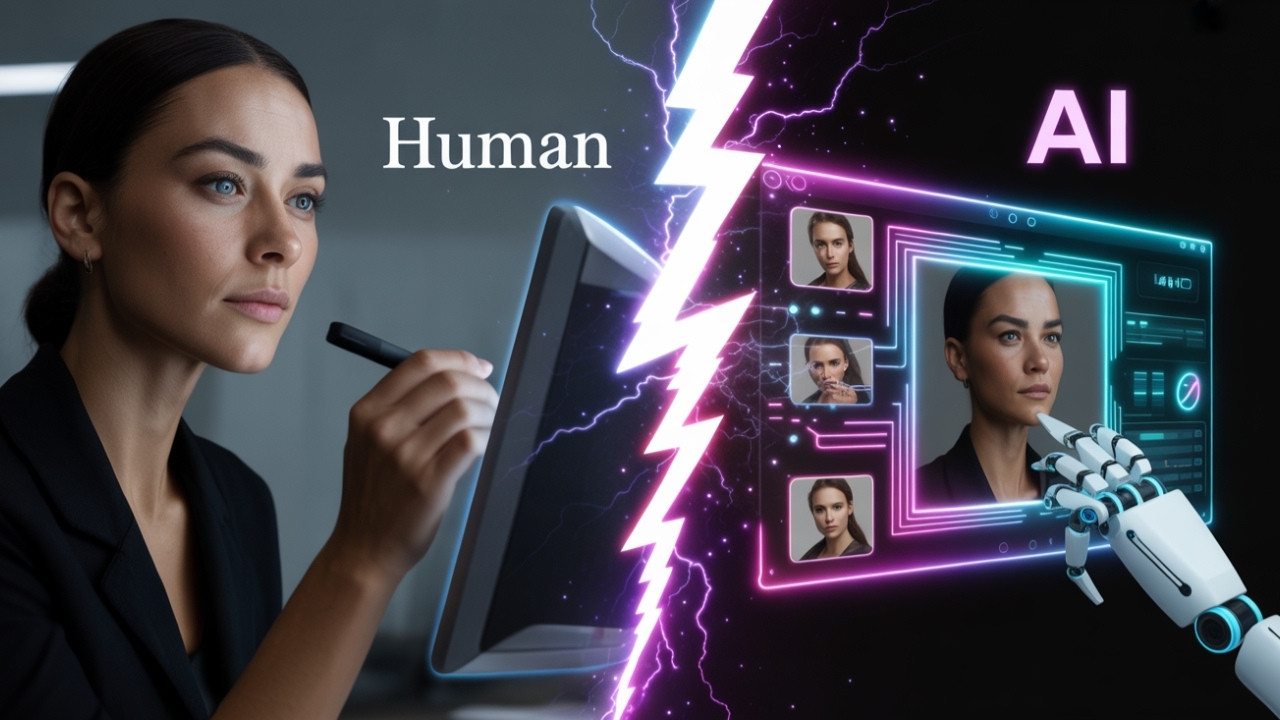
As of November 2025, I no longer receive the daily question, “Do you do retouching?”
It’s “Should I just use AI now, or is it still worth paying for a human?”
I run a professional photo retouching service that delivers several thousand images every month to e-commerce brands, fashion photographers, wedding studios, and advertising agencies.
We have a team of 18 human retouchers… and we also have about a dozen AI tools running 24/7. So believe me when I say: I’m not picking sides for the drama. I’m living in the middle of this every day.
Here’s the real, no-BS state of photo retouching in 2025, written like I’d explain it to a friend over coffee.
The Speed Difference Is Insane (and It’s Not Even Close)
Let’s start with something nobody can argue about: time.
Last week we received 120 product shots of skincare bottles on white. Simple job: clean background, perfect reflections, consistent color, slight shadow, centered labels.
- AI pipeline (Evoto → Retouch4me → custom Photoshop batch): 11 minutes total, fully finished.
- Our fastest human doing the same quality: 5 hours and 12 minutes.
That’s not a small gap. That’s the difference between hitting “upload” before lunch or waiting until tomorrow morning.
If you’re an online store launching collections every week, or a real estate photographer delivering 30 homes a day, AI isn’t “nice to have” anymore. It’s how you stay in business.
When Consistency Is Everything, AI Is Basically Magic
Give the same 300 headshots to five different human editors and you’ll spot the differences immediately: one makes teeth a little whiter, one smooths skin a little more, one warms the color temperature half a stop. It’s subtle, but clients notice.
Run those same 300 through a trained AI workflow and every single person looks like they were photographed in the exact same studio with the exact same lighting and makeup artist. The consistency is actually scary-perfect.
Big corporate clients, school photography chains, and any brand that needs hundreds of images to feel like one cohesive campaign? They switched to AI two years ago and never looked back.
But Then You Open a High-End Beauty Campaign…
…and suddenly AI falls completely on its face.
We just finished a campaign for a luxury skincare brand. The model is 58. The brief: celebrate every laugh line and sun spot, but make her look lit from within, radiant, powerful. Zero plastic skin.
AI gave us three versions:
- Barbie-doll smooth (creepy)
- Left weird blotches around the lips
- Accidentally enlarged one eye by 4%
Our senior retoucher spent four hours rebuilding pore texture by hand, painting realistic light across cheekbones, and keeping the tiny scar above her eyebrow that tells part of her story. The client wrote back: “This is the most beautiful portrait I’ve seen all year.”
That’s not something a machine understands yet — the difference between removing a flaw and removing a life story.
Wedding & Portrait Photographers Are Still 100% Human (and Will Be for Years)
Zoom in on any award-winning wedding photo from 2025. Look at the bride’s eyes during the vows. You’ll see hand-painted catchlights, subtle dodge-and-burn under the eyes that keeps the emotion but removes the exhaustion, and skin that actually looks like skin.
AI either over-smooths and kills the feeling, or it hallucinates weird artifacts around jewelry, veils, and eyelashes. I’ve seen it turn a delicate lace sleeve into modern art that looks like melted plastic.
Your couples aren’t paying $5,000–$15,000 for “good enough.” They’re paying for goosebumps.
The Money Conversation Nobody Wants to Have
Here’s the pricing reality in 2025:
| Type of Work | AI Cost per Image | Human Cost per Image | Hybrid Cost per Image |
| Simple product on white | $0.05 – $0.30 | $0.80 – $2.50 | $0.40 – $1.20 |
| High-end beauty/fashion hero | $0.20 – $1.00 | $6 – $25 | $3 – $10 |
| High-end beauty/fashion hero | Not possible yet | $80 – $500+ | $40 – $200 |
Yes, AI is stupidly cheap for volume work. But the smartest services (ours included) don’t force you to choose.
The Secret Everyone Is Using: Hybrid Is Beating Both
Here’s what the top retouching studios actually do in 2025:
- AI eats the boring 80%
→ Backgrounds, color, exposure, basic skin, cropping, straightening, dust removal - A skilled human does the magical 20%
→ Final skin texture, eye sparkle, dramatic lighting, emotional tweaks, creative direction
The result? Images that used to take 45 minutes and cost $18 now take 10 minutes and cost $5–7 — and they look better than pure human work from 2020.
We ran a split test for an e-commerce client: pure AI vs. hybrid. The hybrid version increased add-to-cart rate by 41%. Speed + soul = money.
So Who Should Use What Right Now?
Use AI (or AI-first services) if:
- You shoot high volume (products, real estate, corporate, events)
- You need consistency across hundreds of images
- Your budget is tight and “really good” is enough
- You’re okay with 95% perfection
Use human or heavy hybrid if:
- You sell emotion (weddings, portraits, family)
- You’re in luxury, fashion, advertising, editorial
- One hero image can make or break a campaign
- Your clients will zoom to 200% and complain about a single catchlight
Where This Is All Going (My Honest Prediction)
By 2027, pure AI will handle 95% of all commercial retouching jobs perfectly. The remaining 5% — the images that make people stop scrolling, cry, or pull out their credit card without thinking twice — will still need a human who understands light, story, and soul.
The best retouching companies aren’t fighting AI. We’re training it to imitate our senior artists, then letting those artists focus on the magic only they can do.
Leave a Reply